Showing posts with label Bees. Show all posts

Sunday, 26 June 2016

Thursley Common & Hankley Common ~ 19 June, 20 June & 26 June

2 visits to new areas of Thursley Common away from the popular Moat Car Park. Effort was concentrated towards the southern end, where mosaic-style management seems to be a lot more prominent and consequently the area is a lot more biodiverse.

Dartford Warbler, Woodlark, Tree Pipit & Redstart are all in good numbers, the latter appearing to have had a particularly good year.

Silver-studded Blues are thinly distributed with the exception of one dense population on the western edge. A ~50m transect yielded 48. Numbers of Bombus lucorum across the site are very impressive along with smaller numbers of hypnorum & terrestris.

Bombus lucorum (M)

Silver-studded Blue


Ammophila wasps were abundant and consequently one lone Mottled Bee-fly (Thyridanthrax fenestratus) was found on my latter visit.

Mottled Bee-fly ~ Thyridanthrax fenestratus


A trip to Hankley Common Golf Course on the 20th June was notable for 1 Mottled Bee-fly but most impressively for Textrix denticulata, seemingly a first for Surrey and a very rare sighting in the SE of England.


Friday, 17 June 2016

Warren Heath/Garden ~ 17 June

First trip of the year was a success with a teneral metallica (my earliest ever) among extremely good numbers of patrolling Downy Emeralds (Cordulia aenea). Keeled Skimmer numbers are building but are some way off their peak. Small-red numbers were noticeably lower than at other sites - the site certainly seems to have deteriorated over the past few years.

A nice surprise upon return to the garden with a Hylaeus confufus nesting in some holes on a concrete fence post (photographed here with a nectar/pollen mix used to fill the nest).


Thursday, 26 May 2016

Goring & Hartslock ~ 26 May

A trip to the well-known concrete bank here where the railway crosses the River Thames south of Goring.

Arriving at around 0915, there was a Common Clubtail halfway through emerging on the bank - very lucky indeed. A series of photos of the emergence is shown below.

Common Clubtail ~ Gomphus vulgatissimus

Common Clubtail ~ Gomphus vulgatissimus

Common Clubtail ~ Gomphus vulgatissimus

Common Clubtail ~ Gomphus vulgatissimus

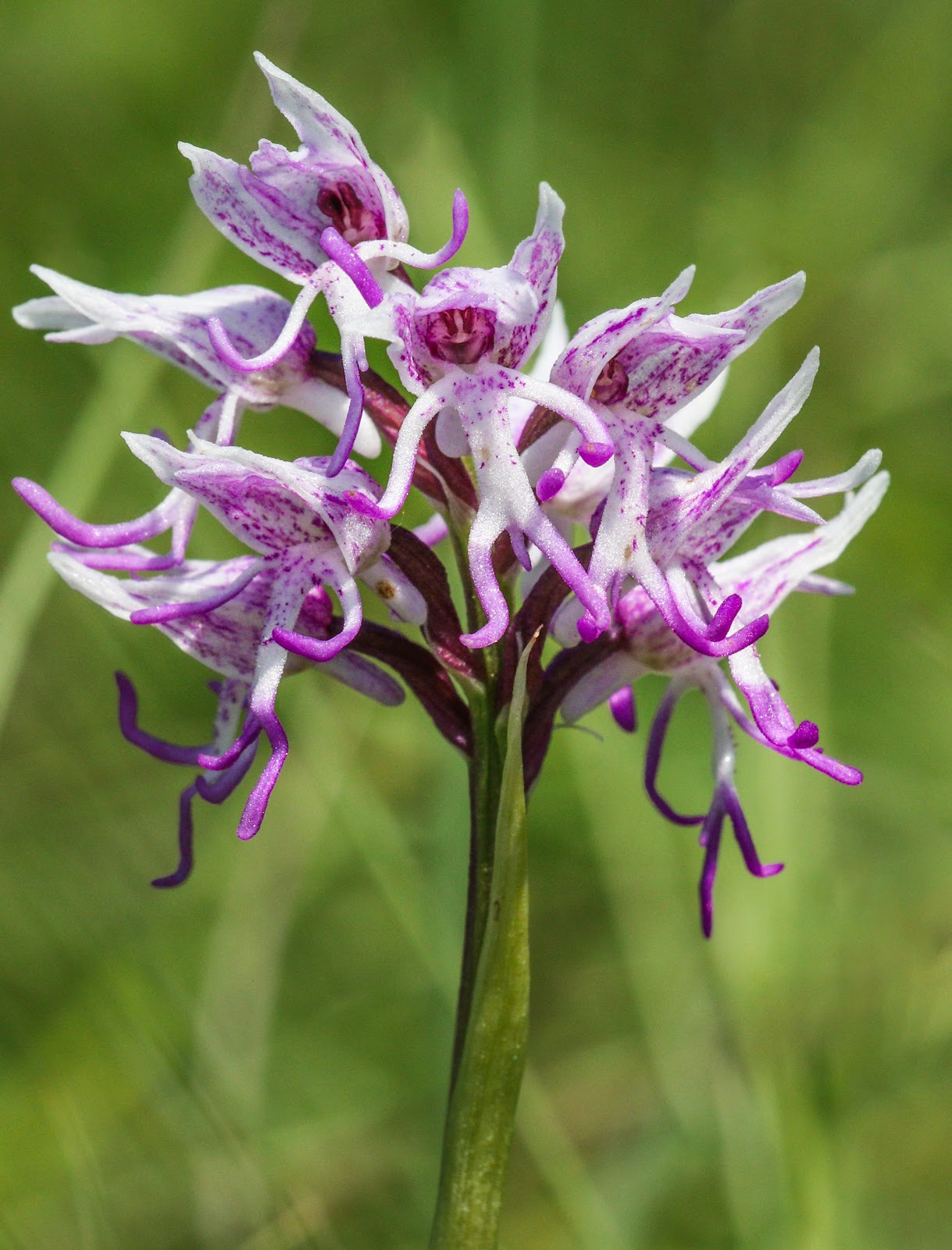
Walking along the Thames to the East, the warm weather encouraged good numbers of Banded Demoiselles, and a female Peregrine circled overhead. Arriving at Hartlock at around 11:30am, there were large numbers of Monkey x Lady Orchid in bloom along with considerably smaller number of Monkey Orchid. No Lady Orchid were present.

Monkey x Lady Orchid ~ Orchis x angusticruris
Monkey Orchid ~ Orchis Simia

Monkey Orchid ~ Orchis Simia
Across the down Dingy Skippers were out in good numbers, along with a few Green Hairstreak and a lone but surprisingly fresh Grizzled Skipper. A good number of Nomada goodeniana were around and a couple of chalkland specialists including Osmia bicolor and Hoplitis claviventris. 

Hoplitis claviventris

Grizzled Skipper ~ Pyrgus malvae


Saturday, 14 May 2016

UEA ~ 14 May

A very quick walk around patch this afternoon was rewarded with excellent views of a male Cuckoo feeding alongside the river to the west of the broad. A second male was singing from within the rabbit enclosure.


Numbers of Nomad bees continue to build in the small clearing to the west of the broad, along with good numbers of Andrena haemorrhoa (females identifiable by the brick red pile on the top of the thorax, orange hairs to the tip of the abdomen and yellow hind tibia) nesting in the bare patches of soil.

Andrena haemorrhoa