Showing posts with label Birds. Show all posts

Sunday, 16 October 2016

Spurn ~ 14 October

A thoroughly enjoyable day, the highlight of which was undoubtedly the Siberian Accentor (UK325) opposite the Easington Gas Terminal.


A walk down the point was profitable with a self-found and very showy Dusky Warbler along with SEO, 30+ Mealy Redpoll, 20 Ring Ouzel, 10 Woodcock, Little Gull, 100 WF Geese, 2 Bean Geese. Perhaps most impressive was the fall of thrushes and finches across the spit, including 60+ Brambling on the beach.


Sunday, 26 June 2016

Thursley Common & Hankley Common ~ 19 June, 20 June & 26 June

2 visits to new areas of Thursley Common away from the popular Moat Car Park. Effort was concentrated towards the southern end, where mosaic-style management seems to be a lot more prominent and consequently the area is a lot more biodiverse.

Dartford Warbler, Woodlark, Tree Pipit & Redstart are all in good numbers, the latter appearing to have had a particularly good year.

Silver-studded Blues are thinly distributed with the exception of one dense population on the western edge. A ~50m transect yielded 48. Numbers of Bombus lucorum across the site are very impressive along with smaller numbers of hypnorum & terrestris.

Bombus lucorum (M)

Silver-studded Blue


Ammophila wasps were abundant and consequently one lone Mottled Bee-fly (Thyridanthrax fenestratus) was found on my latter visit.

Mottled Bee-fly ~ Thyridanthrax fenestratus


A trip to Hankley Common Golf Course on the 20th June was notable for 1 Mottled Bee-fly but most impressively for Textrix denticulata, seemingly a first for Surrey and a very rare sighting in the SE of England.


Thursday, 26 May 2016

Goring & Hartslock ~ 26 May

A trip to the well-known concrete bank here where the railway crosses the River Thames south of Goring.

Arriving at around 0915, there was a Common Clubtail halfway through emerging on the bank - very lucky indeed. A series of photos of the emergence is shown below.

Common Clubtail ~ Gomphus vulgatissimus

Common Clubtail ~ Gomphus vulgatissimus

Common Clubtail ~ Gomphus vulgatissimus

Common Clubtail ~ Gomphus vulgatissimus

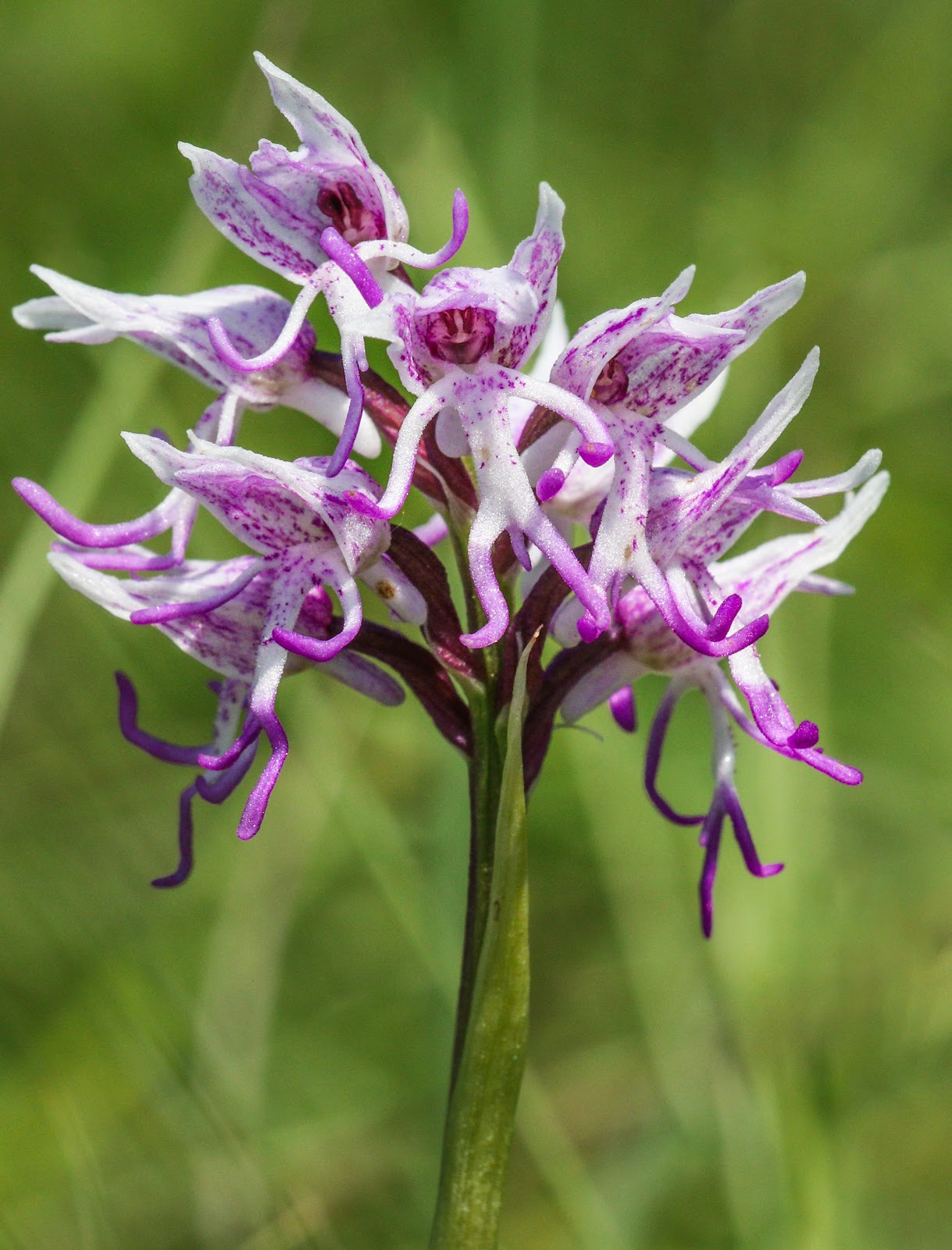
Walking along the Thames to the East, the warm weather encouraged good numbers of Banded Demoiselles, and a female Peregrine circled overhead. Arriving at Hartlock at around 11:30am, there were large numbers of Monkey x Lady Orchid in bloom along with considerably smaller number of Monkey Orchid. No Lady Orchid were present.

Monkey x Lady Orchid ~ Orchis x angusticruris
Monkey Orchid ~ Orchis Simia

Monkey Orchid ~ Orchis Simia
Across the down Dingy Skippers were out in good numbers, along with a few Green Hairstreak and a lone but surprisingly fresh Grizzled Skipper. A good number of Nomada goodeniana were around and a couple of chalkland specialists including Osmia bicolor and Hoplitis claviventris. 

Hoplitis claviventris

Grizzled Skipper ~ Pyrgus malvae


Saturday, 14 May 2016

UEA ~ 14 May

A very quick walk around patch this afternoon was rewarded with excellent views of a male Cuckoo feeding alongside the river to the west of the broad. A second male was singing from within the rabbit enclosure.


Numbers of Nomad bees continue to build in the small clearing to the west of the broad, along with good numbers of Andrena haemorrhoa (females identifiable by the brick red pile on the top of the thorax, orange hairs to the tip of the abdomen and yellow hind tibia) nesting in the bare patches of soil.

Andrena haemorrhoa

Wednesday, 6 April 2016

Altea ~ 30 March - 6 April 2016

A very basic trip report from a holiday that was not focussed on birds/birding but nonetheless yielded some good species. Flights to Alicante were cheap, and I was based in the small town of Pueblo Mascarat on the outskirts of Altea, approximately an hour's drive to the north-east of Alicante.

Although not a birder's typical destination, the area holds a number of sites that are very promising and certainly worthy of further explanation if you find yourself in this region.

Pueblo Mascarat

This hillside town was surprisingly decent with Blue Rock Thrush and 4+ Black Wheatear pairs breeding in the town, the latter regularly performing song-flights from villas and lamposts.
There are large numbers of Pallid Swift breeding, and before temperatures increased large congregations would regularly feed over the town, often accompanied by Common Swifts and small numbers of Alpine Swift and Crag Martin, the latter two breeding on the steep slope by the road-tunnel that heads towards Calp.

Serin, Firecrest & Sardinian Warbler were abundant (as they are everywhere in these parts) though Black Redstart, Woodchat Shrike & Hoopoe were surprisingly scarce. Nightingales breed in the bottom of the dried-river valley and the area generally looks good for migrants that follow the coastline northwards.

Geranium Bronze were seen in the dried river valley along with good numbers of European Swallowtail & Cleopatra.

Black Wheater
Redstart
Cleopatra

Calp

2 sites of interest in this town, the Les Salines saltpans no doubt being the star attraction. Large congregations of 200+ Greater Flamingo and 80+ Black-winged Stilt offer great views from the circular footpath that circumnavigates the waters edge. This area looks amazing for migrants with very good scrapes for passage waders (only LRP on my visit), and the reeds towards the western edge most likely hold Great Reed Warbler etc. Slender-billed Gull appear to be regular. A flock of Little Egret held Cattle Egret and a single Glossy Ibis, and a flock of Whiskered Tern flew through on one visit. Definitely a site worthy of exploration.

Ifach Rock holds a large (Yellow-legged) gull colony and Black Wheatear and Blue Rock Thrush breed on the steep slope. The small area of scrub at the tip of the point is again no doubt a good area for migrants, and also holds breeding Sardinian and Western Subalpine Warbler.

Later in the year, this site reportedly has breeding Eleonora's Falcon, though I failed to find any recent, reliable reports of this species.


Black-winged Stilt 
Little Ringed Plover
Greater Flamingo
'Iberian' Yellow Wagtail

Altea

Where the river (Riu de l'Algar) meets the sea at Altea as marked here there is a small reed-edged pool. The reedbeds hold Little Bittern , and Purple Heron are likely to feed along the river itself (with one individual seen circling for 15 mins).

Audouin's Gull breed nearby and come down to bread. This is a site worth exploring with a record of Baillon's Crake in April 2015 and regular local reports of Squacco Heron.

Purple Swamphens are the 'star attraction' with at least 6 showing well at all times of day, regularly feeding on bread that had drifted into the reedbeds, and when quiet venturing onto the beach.

Large numbers of hirundines roost in the reedbeds during migration, including Red-rumped Swallow.

Audouin's Gull
Purple Swamphen
Purple Heron
Red-rumped Swallow

Sunday, 13 December 2015

North Norfolk Coast ~ 13 December

A morning spent twitching various things along the North Norfolk coast beginning with the juv. Iceland Gull at King's Lynn Docks. This rather brutish individual showed well along the embankment in terrible light, coming into feed on Tesco's finest bread!

Iceland Gull 
Iceland Gull
Moving on to Thornham Harbour, a number of Twite were feeding by the car park and the usual assortment of waders were on the mudflats and saltmarsh. A very showy Red-necked Grebe showed in Brancaster Harbour

Red-necked Grebe

A small flock of White-fronted Geese were seen in their usual field at Holkham and a Cattle Egret was successfully twitched over at Hickling

Cattle Egret

Friday, 30 October 2015

UEA ~ 30 October

A nice find by Michael today in the form of this 1st/w Meditteranean Gull in Earlham Park. My first one on campus and by all accounts rather rare to get on the deck


Sunday, 28 June 2015

Scotland ~ Days 4-6

~ Tuesday ~ 

The day got off to a good start when we opened the moth trap to find 3 Poplar Hawk-moths and 1 Elephant Hawk-moth! We decided to make our way over to the Ardnamurchan Lighthouse, the most westerly point on the British mainland. In the pools by the lighthouse we found several Palmate Newts and offshore we found Guillemot, Razorbill, Black Guillemot and a decent flock of around 40 Manx Shearwater.


Poplar Hawkmoth

Buff tip


On the drive back we ticked off Twite, before arriving at Ben Hiant for a walk, where eventually we picked up a distant soaring White-Tailed Eagle. A Golden Plover flew overhead, Redshank called on the marshes below, and a Whinchat sang from the bracken.

We returned to the cottage where once again the Pine Marten put on a fantastic show...I'll let the photos speak for themselves!


Pine Marten


Pine Marten


Pine Marten


~ Wednesday ~

Crap weather meant that we mainly spent time lounging at the cottage, where we had a couple of sightings of Otter, before unbelievable close views of the Pine Marten in the evening on the step just outside the window.

Pine Marten


~ Thursday ~

We took a day trip to Mull where unbelievably we picked up our first Wheatear of the trip, including several family parties.

Wheatear

Loch Na Keal proved fruitful with 2 otters - most likely a mother and cub - which we followed for a few hundred metres along the loch edge. We also got good views of 2 sub-adult White-Tailed Eagles flying over the loch!

Otters


White-tailed Eagle


We decided to make the long drive down to the island of Iona on the south-western tip of Mull. One of the first discoveries we made was   a white-winged Gull, which initially got us rather excited...until we realised it was just a leucistic Common Gull!

Common Gull (leucistic)

After a short while (including a detour going the wrong way!) we were in the area with the best chance of hearing a Corncrake. With strong winds, rain, and the wrong time of day - I was feeling less than optimistic! Our luck was in however, and over the course of 30 minutes we heard at least 3-4 individuals calling, including one around 5m away. The long vegetation of course meant it was impossible to see them.

We also saw Twite, Skylark, Carrion Crow, Jackdaw and Rook (the latter 2 being quite scarce in this part of Scotland).
On our walk back to the ferry Matt and Megan spotted a Corncrake in a resident's front garden. After an anxious wait, I managed to get a 2-3 second view as it ran from one clump of vegetation to another, a brilliant tick!


Driving back along Loch Na Keal we saw an adult White-Tailed Eagle in a usual spot and then we spotted a recently-fledged juvenile flapping its wings deeper in the forest: an incredible end to what had been a brilliant day.

White-tailed Eagle (phone-scoped)